
Aquatic Weed & Algae Control
── Texas Premier Lake Management
Aquatic Weed & Algae Control in Texas
When a pond that used to shimmer turns into a green mat you can almost walk on, something has gotten out of balance — and it rarely fixes itself. Aquatic weed control and algae control are about reading what's actually happening in the water and treating the cause, not just the symptom. Texas Premier Lake Management is a licensed aquatic applicator serving landowners statewide, and we treat ponds and lakes the way the owner would want them treated: carefully, with the fish and the water chemistry in mind.
Whether you're a ranch owner watching hydrilla creep across your stock tank, an HOA fielding complaints about pond scum, a golf course protecting an irrigation pond, or a municipality managing a stormwater lake, the first move is the same. We identify the plant, we understand the water, and we build a plan around your goals. No guesswork, no spray-and-pray. You deal directly with Cameron — the licensed applicator doing the work — and the company is fully insured.
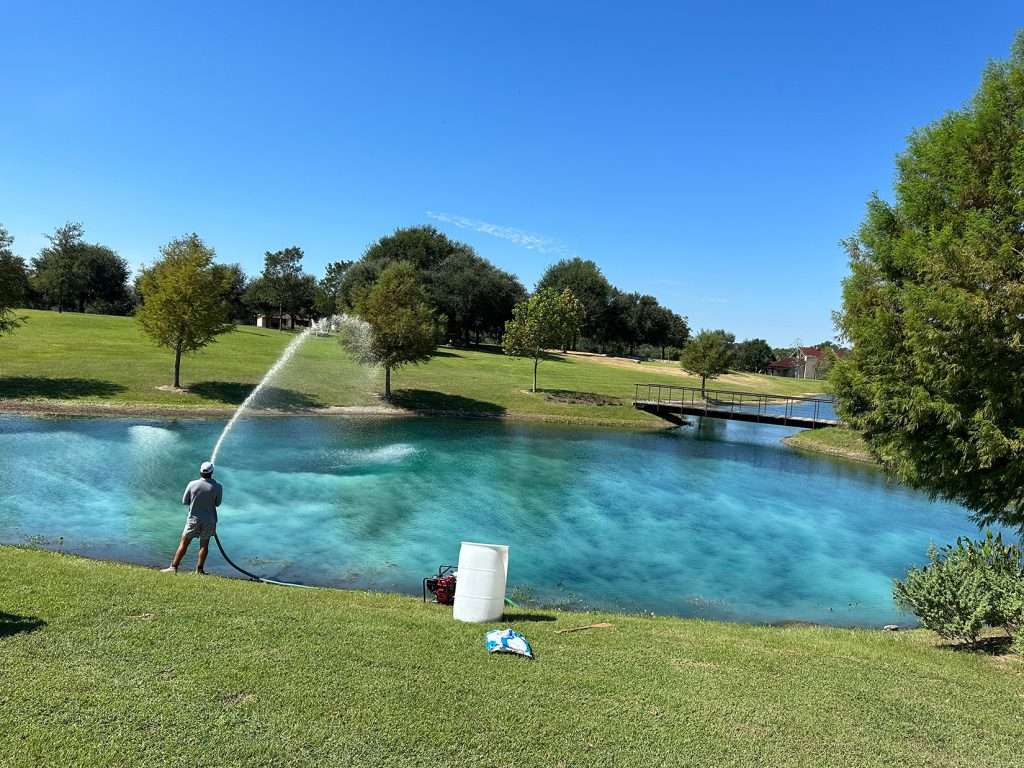
What Our Aquatic Weed & Algae Control Includes
Vegetation problems come in a few flavors, and the right response depends entirely on which one you have. We handle the full range of Texas pond vegetation: submerged invaders like hydrilla, floating mats like giant salvinia and water hyacinth, and the two faces of algae — the stringy filamentous mats that surface in pond corners and the pea-soup planktonic blooms that color the whole waterbody. Our work covers identification, treatment, ongoing prevention, and where it fits, beneficial native planting that crowds out the troublemakers.
Identifying What's Actually Growing
Correct identification drives every decision that follows, because the wrong call wastes money and can make a problem worse. Hydrilla is a good example: it's a non-native invader that's illegal to possess or transport in Texas, and it's easily mistaken for the native Elodea or the non-native Egeria. The tell is in the leaves — hydrilla grows in whorls of four to eight, with one or more small teeth along the underside of the midrib that make it feel rough when you draw a strand through your hand. Get that ID wrong and you might treat a harmless native, or miss a noxious one that's about to take over.
Read More
We are the professionals, and we confirm the species in person before we ever recommend a treatment. If you want to learn more about what grows in Texas ponds, Texas A&M AgriLife's AquaPlant database is the best place to start. If we find a regulated invasive on your property, part of our job is telling you what it is and what the state requires.
Read Less
Treatment Built for the Plant and the Water
As a licensed aquatic applicator, we match the treatment to the plant, the water, and the season. Different vegetation responds to different active ingredients, and the labels carry real water-use restrictions that have to be followed — the label is the law. We test the water before we treat rather than dumping a one-size product into every pond.
Read More
The bigger risk most owners never hear about is what happens after a treatment works. When a heavy stand of vegetation dies off all at once, it decomposes, and that decomposition pulls oxygen out of the water — enough to kill the fish you were trying to protect. On a badly infested pond we'll often treat in sections and let each one break down before moving on, and we pay close attention to pairing treatment with proper aeration to keep dissolved oxygen up while the dead plant material clears.
Read Less
Biological and Beneficial Approaches
Chemistry isn't always the answer. Triploid grass carp are a proven biological tool for certain submerged plants — hydrilla is one of their favorites — but they're heavily regulated in Texas. Only sterile triploid carp are legal here, and you need a triploid grass carp permit from Texas Parks & Wildlife before the fish can be purchased, and they must come from a permitted vendor. Stocking rates matter too — too few do nothing, too many strip a pond bare. We handle the permitting questions and recommend a defensible rate for your situation.
Read More
We also believe in working with the pond. Encouraging the right beneficial native plants can shade out nuisance growth, support the food chain, and stabilize banks — a longer-term fix than spraying the same mat every summer.
Read Less
Our Aquatic Weed Control Process
Every plan is built around your goals and your water, and every job starts the same honest way. It starts with the phone call, where we talk through what you're seeing and whether we're the right fit. Then comes the site visit: Cameron walks the property and looks at the water in person, identifies the vegetation, and checks the conditions that explain why it's thriving — sunlight, depth, nutrient load, water clarity.
From there you get a written plan, not a vague verbal quote. The plan names the target species, the recommended treatment or combination of treatments, any permit steps, and the sequencing needed to protect your fish. Then the work gets done and documented. For invasive infestations and recurring algae, a single treatment is rarely the end of the story, so we build in follow-up rather than disappearing after one pass. If we find a regulated invasive like hydrilla or salvinia, we'll also tell you how to report it to Texas Parks & Wildlife, which the state asks landowners to do.
── Aquatic Weed Control
Why It Matters
for Texas Ponds
Texas is hard on ponds. Long, hot summers push water temperatures up and dissolved oxygen down, and a thick blanket of vegetation or algae makes that worse — floating mats block the surface exchange the pond depends on, and at night the plants themselves consume oxygen rather than produce it. That's the recipe behind a summer fish kill. Giant salvinia, a plant that can double in size in under a week, can cover a surface fast enough to trigger exactly that kind of oxygen crash, and it's a serious and spreading problem across East and coastal Texas. Water hyacinth behaves the same way, forming dense floating mats that choke a pond's surface.
Because the vegetation problem and the oxygen problem are so tightly linked, weed control and aeration go hand in hand. Knocking back the plants without supporting the water's oxygen is half a solution — which is why so many of our treatment plans recommend a properly sized aeration system alongside the spraying. This is the kind of Texas-specific reality that separates real pond management from a generic lawn-and-pond service.
Who This Service Helps
Ranch and acreage owners make up the heart of this work — stock tanks and fishing ponds where hydrilla or filamentous algae is crowding out the open water you actually want to fish. For landowners around Conroe and Montgomery County and out through the ranch country around Bellville, nuisance vegetation is one of the most common reasons the phone rings.
HOAs and community associations call when residents complain about scum, odor, or an unsightly retention pond. Golf courses and commercial properties — irrigation ponds, water features, apartment and RV-park lakes — need treatment that keeps the water functional and presentable without harming the fish. And municipalities managing stormwater ponds and public lakes need an applicator who documents the work and respects the regulations. We serve all of them, statewide, with the same owner-led attention.
Related Services
Weed and algae control rarely stands alone. Because dying vegetation and summer heat both pull oxygen out of the water, our fountains and aeration work is the most natural companion to any treatment plan. If you're not sure why the vegetation keeps coming back, a full pond survey and water-quality assessment can pinpoint the nutrient and clarity issues feeding the growth. And once the water is back in balance, clearing nuisance plants protects your fish stocking goals — open, healthy water is where a fishery thrives.
── Aquatic Weed & Algae Control
Frequently Asked Questions
Do you have a license to apply aquatic herbicides in Texas?
Yes. Texas Premier Lake Management is a licensed aquatic applicator and is fully insured. Aquatic herbicide labels carry real water-use restrictions and the law requires they be followed exactly, so treating a pond is not a job for guesswork or off-the-shelf products. Working with a licensed applicator protects your fish, your water, and you.
How do I know if I have hydrilla or a harmless native plant?
Hydrilla is often confused with the native Elodea and the non-native Egeria. The clearest difference is the leaf: hydrilla grows in whorls of four to eight and has one or more small teeth along the underside of the midrib, which make a strand feel rough when you pull it through your hand. Because hydrilla is an illegal invasive in Texas and the natives are not, we confirm the identification in person and against Texas A&M AgriLife's AquaPlant database before recommending any treatment.
Why did my pond turn green so fast, and is the algae dangerous?
A sudden green color is usually a planktonic algae bloom fed by warm water and excess nutrients, while stringy mats in the corners are filamentous algae. Neither is automatically dangerous, but a heavy bloom that dies off quickly can crash the pond's oxygen and kill fish, especially during a Texas summer. We identify which type you have and treat it in a way that protects dissolved oxygen, often alongside aeration.
Will treating the weeds in my pond kill my fish?
It can if it's done carelessly. The main danger isn't the herbicide itself but the oxygen depletion that follows when a large mass of vegetation dies and decomposes all at once. On heavily infested ponds we treat in sections and let each one break down before moving to the next, and we recommend running aeration — particularly at night — for several days after treatment to keep oxygen levels safe.
Do I need a permit to put grass carp in my pond?
Yes. In Texas only sterile triploid grass carp are legal, and you must hold a triploid grass carp permit from Texas Parks & Wildlife before purchasing them from a permitted vendor. Grass carp can be very effective on plants like hydrilla, but stocking the right number matters and the permitting has to be handled correctly. We walk you through both.
What is giant salvinia and why is it such a problem in Texas?
Giant salvinia is a non-native floating fern that is illegal to possess or transport in Texas and can double in size in as little as four to ten days. When it blankets a pond's surface it blocks oxygen exchange and triggers fish kills, and it has become a significant problem across East and coastal Texas. It's reproduced and spread by fragments, so it requires prompt, professional treatment and reporting to Texas Parks & Wildlife.
Will the weeds and algae just come back after one treatment?
Often, yes — which is why we treat the cause, not only the visible growth. A single application clears the immediate problem, but recurring vegetation usually points to underlying conditions like excess nutrients, shallow clear water, or poor circulation. We build follow-up into the plan and frequently pair treatment with aeration and beneficial planting so the water stays in balance season after season.
Get a Free Aquatic Weed & Algae Control Consultation
If your pond is turning green, matting over, or losing the open water you actually use, the fix starts with a real look at what's growing. Call Cameron at 713-232-9432 or email cameron@texaspremierlakes.com, or tell us about your water through our contact page. We'll identify the problem, build a plan around your goals, and treat it the right way — so you get back the pond you're proud of. Free consultation, no pressure, statewide across Texas.